FinOps for AI: When the Meter Never Stops

Why proving AI’s value now matters more than policing its cost
Ask an enterprise finance leader about the cost of their AI project this quarter. You’ll see the hesitation. It’s not because no one is tracking. Someone is, and it just keeps growing. Forrester’s own client base is voicing these same fundamental questions: Why am I paying this? What is behind it? Where is it headed?
It became a widespread challenge quickly. Just two years ago, only a third of FinOps teams interacted with AI costs at all. In the recent State of FinOps survey, that number grew to 98%, with “FinOps for AI” becoming the number-one priority. The obvious reaction is to throw existing cloud-cost management tools at the challenge. This is where things become quietly problematic.
How the cloud playbook gets it backward
Cloud financial management was born out of costs that, despite being spread out, behaved. Storage and compute were easy to predict. An RDS was a reliable cost. AI workloads resist that treatment. Costs span inference, training, APIs, storage, and observability, driven by volatile demand, expensive GPUs, constant experimentation, and multi-cloud architectures. But even more fundamentally, the billing changes. As vendors abandon predictable, headcount-driven license models and move to consumption-pricing based on the token, the smallest unit of text that a model reads and writes, according to Forrester, enterprises are scaling their AI cost faster than their ability to measure what they get in return, creating a widening value gap where cost is clear, but impact isn’t. Plus, the bill is not just a line on the invoice – data center, power, cooling, and model training sit underneath it.
There is also the AI spend you didn’t sign off on. “Shadow AI” is the term given to AI tools deployed outside of the official process, undermining visibility exactly where accountability should lie. And engineering teams – in true engineer form – optimize for performance before considering cost.
Tracking the spend is the easiest part
This is the awkward truth, the question boardrooms have started to raise. The cost wasn’t the tough number. Value is.
It is evident from Gartner’s “report card” for the finance function in 2026. Out of those finance organizations employing AI, 66% cite efficiency and productivity as the main advantage. Yet 63% say that the deployment took longer than anticipated. And the use cases intended to help the business – financial forecasting and insight generation – had some of the worst scores. The quote to hang above your desk is from Gartner’s Marco Steecker: “Leaders must not mistake activity for impact.” Launching pilots may prove the former but not the latter.
This becomes a concrete playbook in another Gartner study, where efficient growth firms were compared against matched peers. Spending more on AI wasn’t the factor separating the best-performing companies. Deploying AI for both product innovation and customer-facing growth instead of using it just to boost internal efficiency was. Specifically, 46% of the high performers used AI for both innovation and growth, against 32% of the controls. Automating processes by itself had turned into table stakes. And this completely changes the FinOps mandate. The task is no longer making AI cheaper but ensuring you can track enough about its cost to know whether you’re investing in business-building.
Govern it where it runs, not after it lands
So how does one do it correctly? More and more, it looks like reporting the problem too late rather than not at all.
FinOps X 2026 was about rebuilding the operating model while it was happening. The leading FinOps practice was “agentic FinOps,” the three-step process from visibility, to recommendation, to systems that act on optimization decisions themselves, usually via MCP-type architecture that analyzes spend, suggests a remedy, and implements it. The practitioners are combining this with “shift-left” by adding the financial context to the engineering lifecycle before the deployment, to make the cheapest waste something that won’t be provisioned at all. McKinsey makes the economic case by arguing that the discipline should be embedded, coding cost policies into the pipeline, with simple inform, warn, and block rules; it estimates the prize at $120 billion, compared to 28% of cloud spend still being wasted by the organizations.
The need follows the scale, and it is difficult to exaggerate the latter. The enterprises had 28.8 million AI agents in 2025, a number IDC expects to increase eighty times by the end of 2026. However, only 7.5% of them have included FinOps in their AI projects, while 41% of them have wasted over 15% of AI budgets. Several million autonomously operating agents cannot be reconciled against quarterly spreadsheets. Control must live on the platform running them.
That is the gap our NEUPAC™ platform was designed to fill.
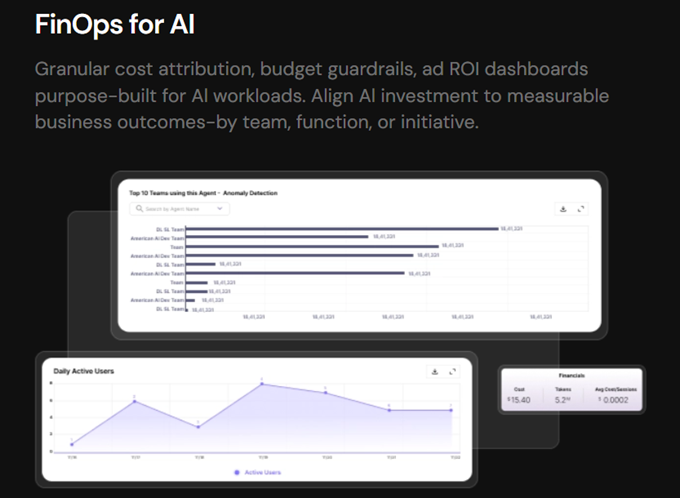
Its FinOps-for-AI module attributes costs at a granular level, establishes budget guardrails, and provides value visibility through ROI dashboards by team, department, and initiative, making the spending no longer a puzzle but a controllable line item. By staying model agnostic and featuring an LLM Zoo for bringing and scaling models and native MCP support, the cost optimization levers that analysts recommend become operational rather than theoretical — be it a smaller model here or freedom from lock-in there. It also exposes shadow AI operations, consolidating millions of agents into a single governed stack. For the CFO who sees unaccounted spend eating away margins, the numbers are tangible: over 40% reduction in LLM cost and 100% spend visibility.
Make the spending explainable and prove the value
This doesn’t mean making AI cheaper through command. It means making AI spend explainable. And as the analysts keep saying, it is the explainability that is the prerequisite of proving value, rather than simply announcing activities. The enterprises that win the race will not be the ones that purchased the most tokens. They will be the ones able to show, line by line, what these tokens have paid for.
That is the task YASH Technologies created NEUPAC™ to accomplish: transform AI from a cost that worries the board to an asset that can be governed, optimized and scaled at the discretion of the board.
If your AI bill has started moving faster than your ability to read it, explore how NEUPAC™ brings FinOps discipline to enterprise AI, and let’s make the spend make sense.
- AI FinOps
- FinOps
- Generative AI
Know our Author

Lokesh Sapre
Principal Product Manager - NEUPAC™

Related Posts.

Who Gave the Agent Permission?
Lokesh Sapre